
Rockwool Insulation in Nepal: Thermal, Fire and Acoustic Guide
Use rockwool effectively in walls, roofs, ceilings and acoustic systems with guidance on density, thickness, fire performance, moisture and installation.
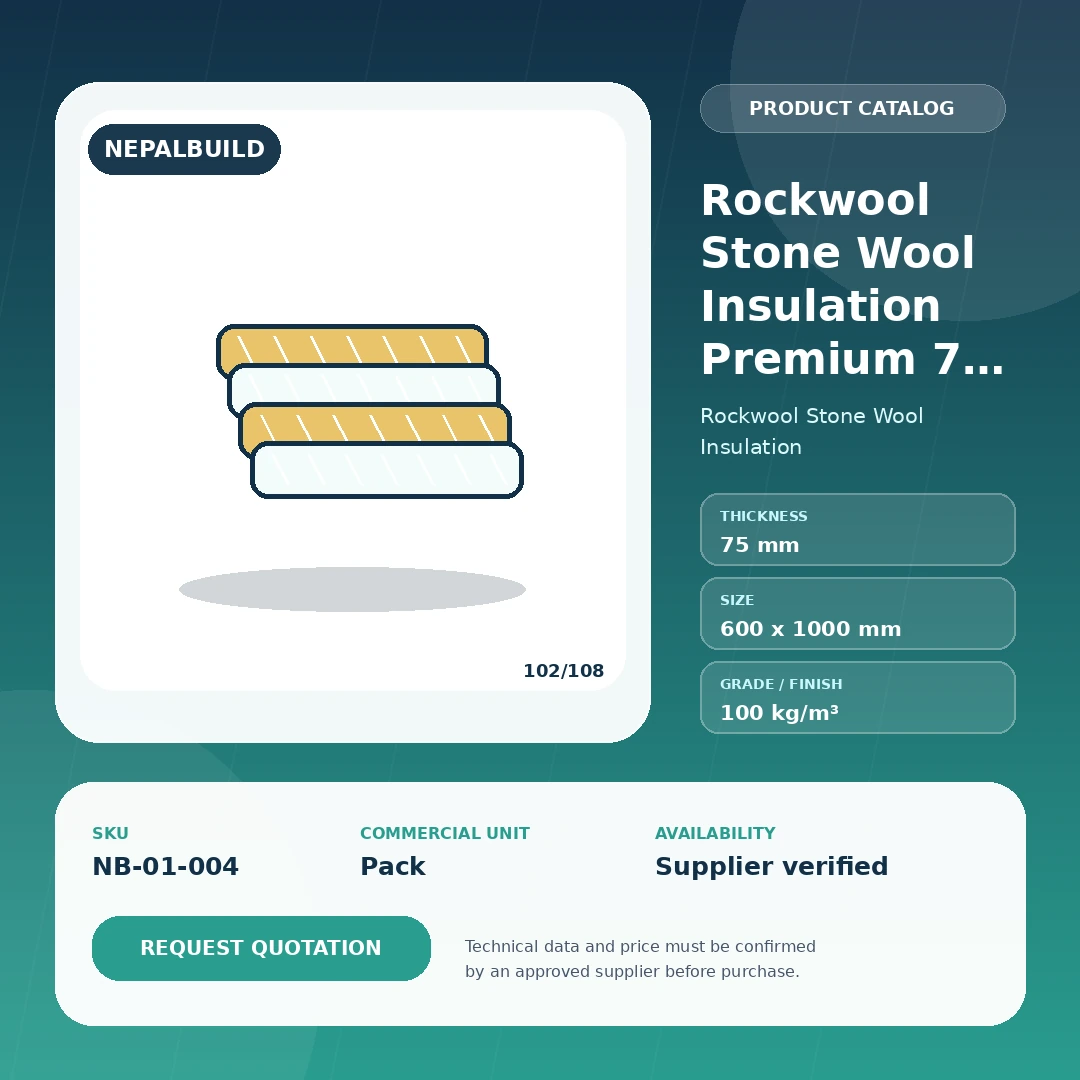
Rockwool, also called stone wool, is used in building envelopes, partitions, ceilings and mechanical applications because one material can contribute to thermal, acoustic and fire performance. The correct product still depends on density, thickness, facing, compression and the complete assembly around it.
Understand density and thickness
Thickness primarily affects the path for heat flow, while density influences stiffness, handling and acoustic behaviour. A denser board is not automatically a better thermal insulator for every application.
Select the manufacturer-recommended product for the wall, roof, partition or equipment application.
Use it continuously in walls
Fit slabs tightly between studs without leaving voids around services or edges. Avoid excessive compression because it changes the designed thickness and can create uneven coverage.
Where continuous exterior insulation is required, coordinate fixings, weather protection and cladding support.
Detail roofs and ceilings carefully
In roof and ceiling applications, support the insulation so it does not sag or leave gaps. Coordinate vapour control and ventilation with the roof type and local climate.
Keep insulation clear of heat-producing equipment where the equipment manufacturer requires separation.
Pair rockwool with acoustic assemblies
Inside partitions, stone wool can absorb energy in the cavity and support better sound isolation. Performance still depends strongly on the boards, framing, resilient connections and airtightness.
For room treatment, rockwool is usually covered with an acoustically transparent facing and protected from damage.
Use verified fire-rated systems
Stone wool is often selected in fire-resistance assemblies, but the rating belongs to the tested or engineered system rather than the insulation alone.
Follow the specified board layers, fasteners, joints, penetrations and fire-stopping details.
Protect material during storage and installation
Store packs dry, off the ground and protected from weather. Cut accurately with suitable tools and follow safe handling guidance to minimise dust and skin irritation.
Close the assembly after inspection so displaced pieces are not hidden behind the finish.
Practical project checklist
- Confirm product density and thickness from the design.
- Keep insulation dry before enclosure.
- Fit pieces without gaps or unnecessary compression.
- Coordinate vapour, air and weather-control layers.
- Use complete tested assemblies for fire-rated work.
Questions to ask before you buy
- Is rockwool waterproof?
- Does higher density always mean better insulation?
- Can rockwool be used for both heat and sound?
Final takeaway
Rockwool is versatile, but it performs best when the product is matched to the assembly and installed continuously. Treat fire, moisture, acoustics and thermal control as system-level requirements.
Need a project-specific recommendation? Send NepalBuild your quantities, location and delivery timeline on WhatsApp at +977 970 3036403. We can help you compare materials, specifications and quotation options before ordering.
Need current product prices or a project quotation?
Send your quantities, location and required delivery date. NepalBuild will help structure a comparable supplier enquiry.
Related construction guides
Insulation and Condensation in Nepal: What Builders Should Coordinate
Understand why condensation forms and how insulation, ventilation, air leakage and vapour control should be coordinated in walls and roofs.
Top 10 Best Thermal Insulation Materials for Energy-Efficient Buildings in Nepal
Compare thermal insulation for roofs, walls, ceilings, HVAC ducts and cold regions in Nepal.
Best Thermal Insulation Materials for Walls in Nepal
Compare rockwool, glasswool, EPS, XPS and reflective insulation for Nepali walls based on climate, moisture, fire performance and installation.